
There is a number nobody talks about when they buy a $400 sofa. It is not the price tag. It is the number of times they will buy that same sofa over the next fifteen years. Run that math and the story changes completely.

The Disposable Furniture Cycle Is a Subscription You Never Signed Up For
Most people do not think of their furniture as a recurring expense. But that is exactly what it becomes when the frame warps, the cushion collapses, or the finish peels within three years of purchase. You go back. You buy again. Sometimes the same piece. Sometimes a slightly different version of the same mistake.
The average mass-market sofa has a functional lifespan of 3 to 5 years under normal residential use. A piece priced at $500 replaced every 4 years costs $1,250 over a decade. A commercial-grade sofa built to last 15 to 20 years costs more at the point of purchase and far less over the course of ownership. The math is not subtle.
- Cheap furniture cost over 10 years: $500 sofa replaced 2 to 3 times equals $1,000 to $1,500, plus delivery fees each time
- Investment furniture cost over 10 years: One well-built piece, one delivery, no replacement cycle
- Hidden cost of disposable: The time spent shopping, waiting for delivery, and living with something you already know is temporary
Tariffs Have Changed the Equation Even Further
The 2025 and 2026 tariff landscape has done something unexpected: it has made cheap imported furniture more expensive while doing almost nothing to improve its quality. The production cost of mass-market furniture has risen sharply, and those increases have been passed directly to the consumer. You are now paying more for the same compromised materials, the same short lifespan, and the same replacement cycle.
Meanwhile, artisan-crafted furniture built on iron frames, solid white oak, and commercial-grade upholstery absorbs cost increases differently. When your frame is hand-welded and your fabric is sourced from Belgium, the cost structure was never anchored to the same cheap import pipeline that tariffs are now disrupting. The gap between mass-market and investment-grade furniture in terms of price has narrowed. The gap in quality has not moved at all.
What House of Leon Was Built to Solve
House of Leon was founded in Los Angeles by two people who grew up learning to prioritize individuality over imitation. The goal was never to compete on price with mass-market furniture. The goal was to prove that atelier craftsmanship and genuine design could exist at a price point that did not require a multi-generational inheritance to access.
Every collection at houseofleon.com is designed with that tension in mind. Old-world craft. Modern living. No shortcuts on the frame, the finish, or the fabric. Each piece is described internally as a future heirloom, which is not marketing language. It is a construction standard. If it is not built to be passed down, it does not belong in the catalog.
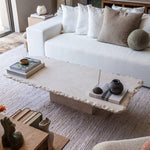
The Collections That Embody This Philosophy
Every collection in the leon furniture lineup was designed around materials and construction methods that reject the disposable model by default.
- The Milan Collection: Cast iron frames inspired by the industrial I-beam. Built to the same structural logic as architecture, not seasonal retail cycles.
- The Ojai Collection: Natural white oak that ages with the room rather than degrading inside it. Material honesty as a design principle.
- The Provence Collection: Powder-coated iron and Belgian weather-proof boucle. An outdoor collection that develops a natural patina over 15 years rather than cracking, fading, or warping in half that time.
- The Shou Sugi Ban Collection: Ancient Japanese charred-wood technique applied to contemporary furniture. A finish that becomes more itself over time, not less.
The Anti-Disposable Argument in Numbers
| Furniture Type | Avg. Lifespan | Replacement Cycles (15 yrs) | Total Cost Est. | Resale or Heirloom Value |
|---|---|---|---|---|
| Mass-market flat-pack | 2 to 4 years | 3 to 7 times | $1,500 to $3,500+ | None |
| Mid-market upholstered | 4 to 7 years | 2 to 3 times | $2,000 to $4,500+ | Minimal |
| House of Leon (investment-grade) | 15 to 20+ years | 0 to 1 times | Purchase price, once | High. Passes down. |
Individuality Is Not a Trend. Neither Is Quality.
The founders of House of Leon built this brand around one quiet conviction: your home should reflect who you are, not what was easiest to ship in a flat box from a warehouse. That conviction has never been more relevant than it is right now, when the market is flooded with furniture that costs more than it used to and lasts exactly as long as it always did.
Buying once is not a luxury mindset. In 2026, it is the logical one. The anti-disposable furniture movement is not a niche aesthetic position. It is a response to an economic reality that mass-market retail is not built to solve. houseofleon.com is.